Your cart is empty.
- Categories

BPC-157 is a synthetic pentadecapeptide studied in controlled laboratory models of tissue signalling. This article outlines how researchers examine the compound in cell-based assays and related in-vitro systems. It does not describe human or animal use.
BPC-157 is a synthetic peptide consisting of 15 amino acids. Amino acids are the small molecular units that form peptides and proteins. The term pentadecapeptide refers specifically to a peptide containing 15 amino acids.
In research settings, BPC-157 may be supplied as a lyophilized material. Lyophilized means that the material has been freeze-dried to support storage and handling before preparation for an approved laboratory protocol.
Researchers evaluating a BPC-157 10mg research peptide should review the applicable certificate of analysis, purity information, storage requirements, and laboratory documentation before incorporating the material into a protocol.
The compound is generally discussed within the broader field of regenerative peptides. In this context, the term describes peptides investigated in laboratory models involving cellular communication, matrix biology, and related molecular processes. It does not imply an approved clinical application.
Tissue signalling refers to the molecular communication that coordinates activity between cells and their surrounding environment. Researchers use tissue-signalling models to examine whether a compound is associated with changes in defined cellular or molecular markers.
An in-vitro research model is a controlled laboratory system studied outside a whole organism. Depending on the research question, these systems can include cultured cell lines, primary cells, three-dimensional cell cultures, or simplified biochemical assays.
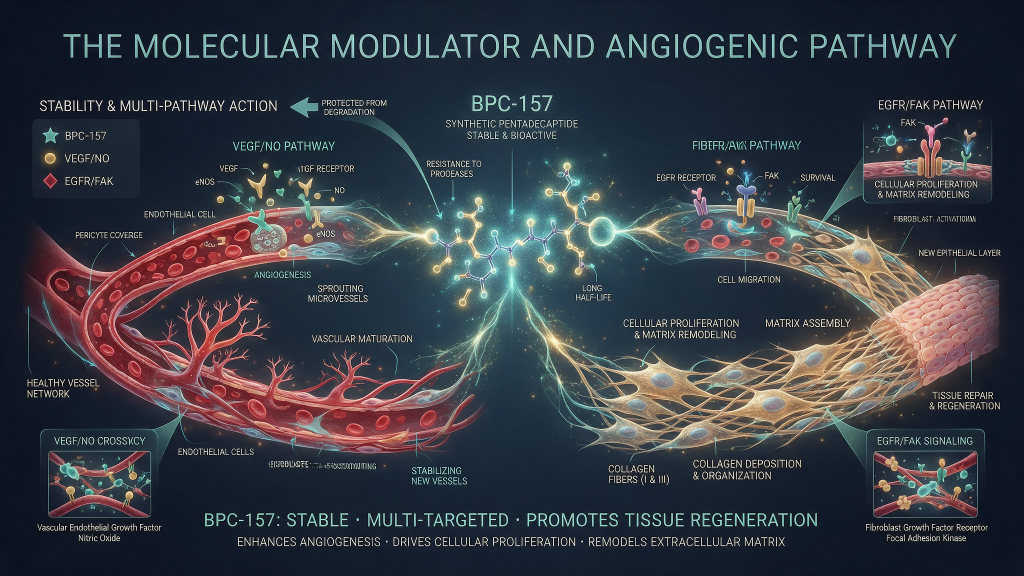
A typical study may expose a selected cell system to defined concentrations of a research compound. Researchers then measure predetermined endpoints using methods such as:
A cell-signalling assay is a test designed to detect activity within a defined communication pathway. The assay may examine receptor activity, intracellular messenger proteins, transcription factors, or changes in gene expression.
Strong experimental design is important when interpreting any BPC-157 research model. Relevant controls may include untreated cells, vehicle controls, positive pathway controls, and technical replicates. Researchers may also assess assay linearity, peptide stability, exposure duration, and possible interference with detection reagents.
Research interest in BPC-157 includes examination of signalling networks involved in cellular communication. A signalling network is a series of molecular interactions that transmits information from a receptor or extracellular cue to processes inside the cell.
Depending on the model, investigators may measure markers associated with:
Phosphorylation is the addition of a phosphate group to a protein. This modification can alter protein activity and is commonly measured as an indicator of pathway activation or regulation.
The exact pathway selected depends on the cell type, assay design, exposure conditions, and research objective. A result observed in one cell system may not translate directly to another model. For this reason, BPC-157 should be evaluated as a research variable within a defined experimental framework rather than as a general-purpose signalling agent.
Cytoprotective means related to mechanisms that help maintain cellular integrity under defined experimental stress conditions. In a laboratory model, researchers may use this term when studying markers associated with membrane stability, oxidative balance, mitochondrial activity, or regulated cell-signalling responses.
Oxidative balance describes the relationship between oxidizing molecules and the cellular systems that regulate them. Mitochondrial activity refers to measurable processes within mitochondria, the cell structures involved in energy metabolism.

A cytoprotective pathway research model may therefore examine:
These endpoints must be interpreted carefully. A change in a marker does not establish a complete biological mechanism. It indicates that a specific measurement differed under the conditions used in the experiment.
Researchers may select BPC-157 for exploratory synthetic peptide research because its small and defined sequence allows it to be evaluated in controlled assay systems. A defined sequence is a known, ordered arrangement of amino acids that can be described and compared across experiments.
The compound may also be of interest in studies that examine relationships between extracellular signals and intracellular responses. Extracellular signals are molecular cues located outside a cell. Intracellular responses are the changes that occur inside the cell after the cue is detected.
BPC-157 can be investigated alongside other research compounds when a study is designed to compare:
Comparative research requires consistent methods. Cell density, culture medium, passage number, incubation conditions, peptide preparation, and analytical timing can all influence the measured result. Researchers should define these variables in advance and report them clearly.
Interest in BPC-157 may also reflect broader efforts to characterize peptide-based signalling tools. However, laboratory observations should remain limited to the model and endpoints tested. They should not be presented as evidence of clinical efficacy, safety, or suitability for human or animal use.
Lyophilized peptide materials should be handled according to the supplier’s documentation and the requirements of the relevant laboratory. Researchers should confirm storage conditions, packaging information, lot identification, purity data, and reconstitution instructions before beginning an experiment.
Reconstitution means adding a specified laboratory solvent to a dried material to create a prepared research solution. The solvent, concentration, mixing method, and storage period can affect peptide integrity and should be defined in the protocol.
Before using a BPC-157 10mg research peptide, researchers should establish:
A research team may also compare available presentation formats when designing a procurement plan. Product specifications should be reviewed directly because formulation, packaging, and documentation can vary between products.
BPC-157 is presented here as an object of laboratory investigation in tissue-signalling and cell-signalling models. The discussion is limited to synthetic peptide research, assay design, molecular markers, and controlled in-vitro systems.
No conclusions about human or animal use should be drawn from this article. Researchers are responsible for following applicable institutional, regulatory, bio-safety, and chemical-handling requirements.
For research use only. This content is provided for in-vitro laboratory research purposes. The compounds discussed are not for human consumption and are not approved by the FDA or EMA to prevent, treat, or cure any condition. Introduction into humans or animals is prohibited by law.
References
Sikiric, P., et al. (2021). “Stable Gastric Pentadecapeptide BPC 157: Inflammatory Bowel Disease Therapy.” Biomedicines, 9(10), 1389.
Sikiric, P., et al. (2018). “Peptide BPC 157 and the Angiogenic Pathway: The Counteraction of Angiogenic Inhibitor Effects by BPC 157.” Current Pharmaceutical Design, 24(19), 2111-2121.
Seiwerth, S., et al. (2021). “BPC 157 and Blood Vessels: The Therapy of the Impaired Healing Pathways.” Biomedicines, 9(10), 1385.
Sikiric, P., et al. (2014). “Stable Gastric Pentadecapeptide BPC 157: Implications for Novel Therapeutic Potential in Different Organ Systems.” Journal of Physiology-Paris, 108(4-5), 245-254.
Sikiric, P., et al. (2020). “Stable gastric pentadecapeptide BPC 157: Rectifying the failing EGFR and PDGF receptor pathways to resolve the stubborn muscle healing.” European Journal of Pharmacology, 874, 172973.
Strbe, M., et al. (2022). “Stable Gastric Pentadecapeptide BPC 157: Spinal Cord Injury and Traumatic Brain Injury Therapy.” Biomedicines, 10(5), 1089.
