Your cart is empty.
- Categories

Incretin receptor pathways are a core focus in metabolic peptide research. This field examines how certain receptors on cell surfaces respond to signalling molecules. These receptors help control metabolic processes in laboratory models. Researchers use this pathway to understand basic receptor biology.
Incretins are a group of metabolic hormones. In plain language, these are natural chemical messages that influence how cells manage energy. In biological systems, incretins are released after nutrient intake. In laboratory research, incretins are studied as isolated molecules. Two main incretins are GLP-1 and GIP. GLP-1 stands for glucagon-like peptide-1. GIP stands for glucose-dependent insulinotropic polypeptide. These names describe their structure and origin. Researchers study incretins in vitro to map receptor activity. In vitro means the work takes place outside a living organism, often in cell cultures or test tubes.
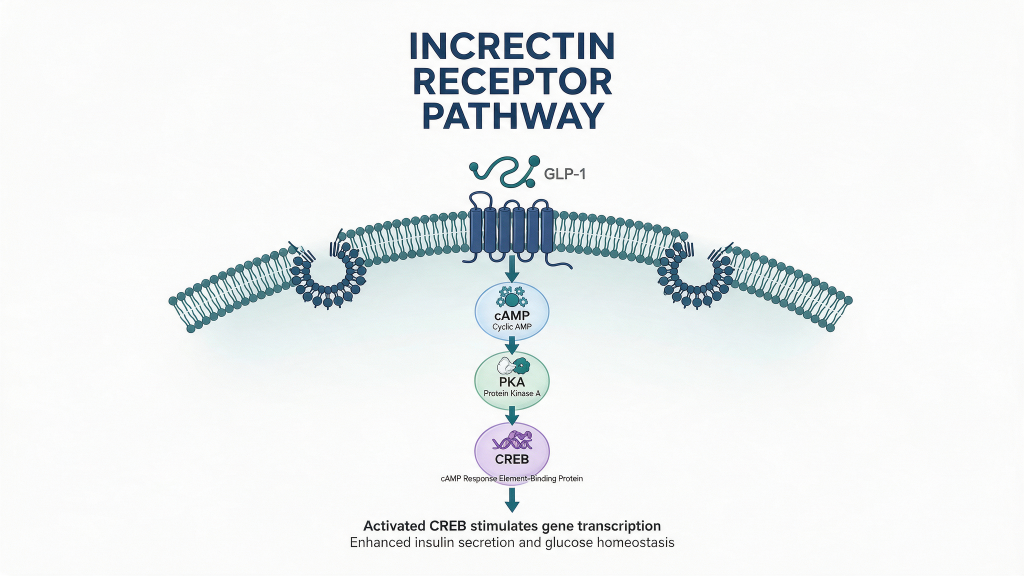
The incretin receptor pathway is a chain of molecular events. In plain language, it is the route a signal takes from outside a cell to inside a cell. A signalling molecule binds to a receptor. The receptor changes shape. This change triggers intracellular signals. Researchers map each step in this process. The pathway includes two main receptor types. These are the GLP-1 receptor and the GIP receptor. Both are proteins on cell membranes. They are common targets in metabolic peptide studies. The term metabolic peptides refers to short chains of amino acids. In plain language, amino acids are the building blocks of proteins, and these peptide chains can bind to metabolic receptors.
GLP-1 receptor signalling is a key area of study. The GLP-1 receptor binds the GLP-1 peptide. In plain language, the receptor is like a lock and the peptide is like a key. When the key fits, the receptor sends a signal inside the cell. This signal activates enzymes and second messengers. Researchers measure these signals in cultured cells. The GLP-1 receptor belongs to the class B G protein-coupled receptor family. G protein-coupled receptors are a large group of membrane proteins. In plain language, these proteins sit in the cell membrane and pass signals from outside to inside. In vitro assays often use cell lines that express the GLP-1 receptor. A cell line is a population of cells grown in the laboratory. Scientists add a peptide and record the cellular response. This helps map receptor dynamics.
The term receptor signalling describes the entire chain of events that starts with binding and ends with a change inside the cell. In plain language, it is the message-sending process that cells use to respond to outside signals. Researchers study GLP-1 receptor signalling to understand how this specific lock-and-key system operates. They may measure signal strength, duration, and downstream markers. These measurements are performed in controlled laboratory settings. No human-use outcomes are implied.
GIP receptor signalling follows a similar pattern. The GIP receptor binds the GIP peptide. This receptor also belongs to the G protein-coupled receptor family. In plain language, the GIP receptor works like another lock-and-key system. GIP receptor signalling influences different intracellular pathways. Researchers compare GLP-1 and GIP receptor responses. Differences can reveal distinct roles in metabolic regulation. Laboratory models use both receptors to study combined effects. Some research peptides target one receptor. Others target both receptors. Dual agonists are a growing area in metabolic peptide research. A dual agonist is a molecule that binds to two different receptors. In plain language, it is a key that can fit two different locks.

Metabolic peptides are short chains of amino acids. In plain language, amino acids are molecules that link together to form proteins, and short chains are called peptides. These peptides can bind to metabolic receptors. Researchers use them to study energy balance and glucose handling in laboratory systems. This category includes synthetic and natural peptides. Some are designed to resist breakdown in assay conditions. Others are used as reference standards. The Elivena metabolic peptides category includes several products for laboratory use. This hub focuses on incretin-related peptides.
Several peptides appear often in incretin receptor research. Semaglutide is one example. Semaglutide is a peptide that binds the GLP-1 receptor. In plain language, it mimics the natural GLP-1 key in laboratory assays. Researchers may use Semaglutide 10 mg or Semaglutide 5 mg in binding studies. These product variants allow flexible experimental design.
Another peptide is Tirzepatide. Tirzepatide interacts with both GLP-1 and GIP receptors. In plain language, it can fit two different locks. Researchers may order Tirzepatide 10 mg or Tirzepatide 15 mg for receptor studies. These compounds are for laboratory use only.
| Component | Role In Laboratory Research |
|---|---|
| GLP-1 receptor | Binds GLP-1 and related peptides in cell assays |
| GIP receptor | Binds GIP and related peptides in cell assays |
| Semaglutide | Peptide used in GLP-1 receptor binding studies |
| Tirzepatide | Peptide used in dual GLP-1 and GIP receptor studies |
Researchers use in vitro models to study receptor signalling. In plain language, these models use cells or molecules outside a living body. A receptor can be expressed in a cell line. A peptide can be added at a known concentration. Signal strength and duration can be measured. This data helps build mechanistic models. It does not describe outcomes in humans. The work supports basic science and drug discovery assays.
Binding affinity is a common measurement in these studies. Binding affinity is the strength of the interaction between a molecule and a receptor. In plain language, it describes how tightly a key fits a lock. Researchers also measure signal transduction. Signal transduction is the process by which a receptor signal leads to changes inside a cell. In plain language, it is the cell passing the message along after the key turns the lock.
This article only describes laboratory research uses. Researchers study binding, signalling, and stability. They do not study human dosing or therapeutic outcomes. The following points apply to all Elivena metabolic peptides:
This article is for informational purposes only. It does not provide medical or therapeutic advice. Elivena products are for laboratory research use only. They are not for human use or clinical applications. No outcomes in humans are implied. Researchers must comply with all applicable laws and institutional guidelines. Explore the metabolic peptides category for available research compounds.
