Your cart is empty.
- Categories

When researchers explore regenerative peptides, two compounds frequently appear in laboratory literature: BPC-157 and TB-500. Both are studied in tissue signalling research models. Both attract attention in regenerative peptide research. Yet they differ in structure, mechanism focus, and handling requirements.
This article compares BPC-157 and TB-500 across key categories relevant to in-vitro laboratory research. It describes what each compound is and what is studied about it. It does not describe what either compound does to a person.
BPC-157 is a pentadecapeptide. A pentadecapeptide is a peptide chain made of exactly 15 amino acids. “Penta” means five. “Deca” means ten. Together, pentadeca means fifteen. A peptide is a short chain of amino acids linked by peptide bonds.
BPC-157 is derived from a peptide fragment found in human gastric juice. A peptide fragment is a shorter piece cut from a longer protein chain. The parent protein is called Body Protection Compound, or BPC. The “157” refers to the specific 15-amino-acid sequence isolated from that parent protein.
In laboratory research, BPC-157 is studied for its interactions with tissue signalling pathways. Tissue signalling refers to the way cells communicate with each other using chemical messengers. These messengers influence how cells behave during repair processes studied in vitro.
Researchers can find BPC-157 10mg available for laboratory use. Additional dose variants include BPC-157 20mg and 500mcg x30 tablets, depending on research requirements.
TB-500 is a synthetic version of a peptide fragment called Thymosin Beta-4. Thymosin Beta-4 is a naturally occurring protein found in many tissues. It consists of 43 amino acids in its full-length form.
TB-500 uses a shorter active region of that full-length protein. The specific fragment studied most often is the active site responsible for binding to actin. Actin is a structural protein inside cells. It forms part of the cytoskeleton, which gives cells their shape and allows them to move.
The “TB” in TB-500 stands for Thymosin Beta. The “500” is a naming convention used by researchers and does not indicate a dose or concentration.
In research models, TB-500 is studied for its role in angiogenic pathways. Angiogenesis is the process by which new blood vessels form from existing ones. This process is a key area of study in tissue signalling research.
Researchers can find TB-500 10mg available for laboratory use.
Understanding the structural differences between BPC-157 and TB-500 helps researchers choose the right compound for their in-vitro models.
BPC-157 Structure:
A Dalton is a unit used to express the mass of molecules. One Dalton equals approximately the mass of a single hydrogen atom.
TB-500 Structure:
Key Structural Difference:
BPC-157 is a complete pentadecapeptide derived from a larger parent protein. TB-500 is a synthetic fragment representing only part of the full Thymosin Beta-4 sequence. This difference in origin and completeness influences how each compound behaves in research assays.
Both compounds appear in regenerative peptide research, but they are studied in different focus areas.
BPC-157 Research Areas:
TB-500 Research Areas:
Overlap And Distinction:
Both compounds are studied in angiogenic pathway research. Both appear in endothelial cell studies. However, BPC-157 research often emphasizes tissue signalling through nitric oxide and growth factor interactions. TB-500 research often emphasizes actin binding and cytoskeletal dynamics. Researchers choose based on which pathway is most relevant to their specific in-vitro model.
Proper handling ensures research compounds remain viable for laboratory use. BPC-157 and TB-500 have different stability profiles.
BPC-157 Handling:
TB-500 Handling:
Handling Comparison:
Both compounds arrive as lyophilized powders. Both require cold storage before reconstitution. Both have limited stability after reconstitution. Researchers must plan experiments to use reconstituted solutions within appropriate time-frames. Neither compound should be subjected to repeated freeze-thaw cycles, as this can degrade the peptide structure.
Researchers often ask which compound works better in specific assay types. The answer depends on the research question.
Cell Culture Models:
Signalling Pathway Assays:
Migration Assays:
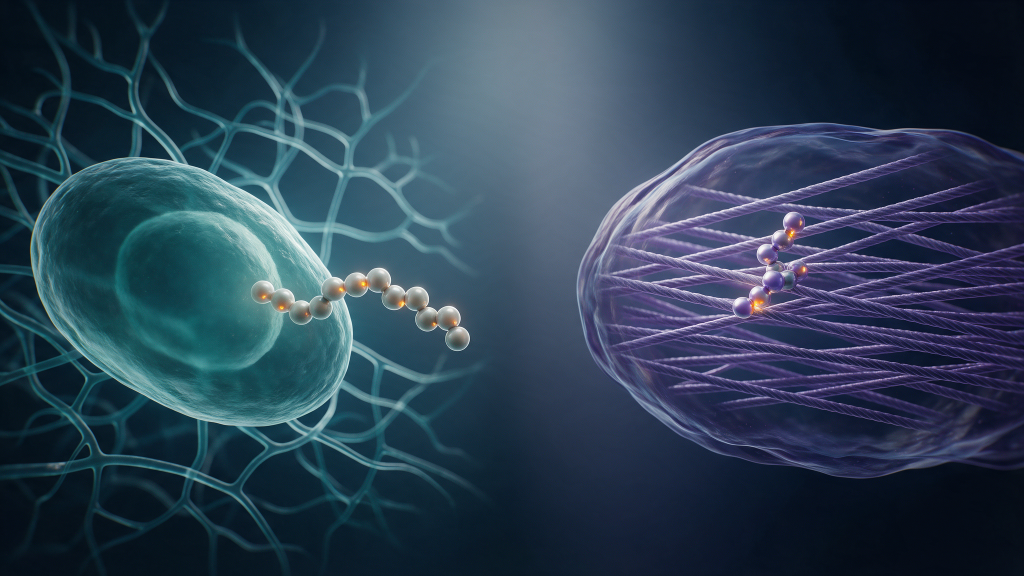
Some researchers study both compounds together in combination models. The Wolverine blend (BPC-157 + TB500) contains both peptides in a single formulation. A Wolverine BPC-5mg/TB-5mg variant is also available for researchers who require smaller amounts of each compound in their in-vitro studies.
Combination research allows investigators to observe how both peptides interact within the same assay system. This approach is relevant when researchers want to study overlapping tissue signalling pathways simultaneously.
The choice between these two compounds depends on the research question, not on any therapeutic consideration.
Choose BPC-157 when:
Choose TB-500 when:
Choose the Wolverine blend when:
For deeper exploration of these topics, see these related articles:
For research use only. This content is provided for in-vitro laboratory research purposes. The compounds discussed are not for human consumption and are not approved by the FDA or EMA to prevent, treat, or cure any condition. Introduction into humans or animals is prohibited by law.
References
Smart, N., et al. (2007). “Thymosin β4 induces adult epicardial progenitor mobilization and coronary vessel formation.” Developmental Biology, 304(2), 516-528.
Sikiric, P., et al. (2018). “Stable gastric pentadecapeptide BPC 157 is a novel therapy for gastrointestinal inflammatory disease.” Current Pharmaceutical Design, 24(27), 3193-3202.
Sikiric, P., et al. (2020). “Pentadecapeptide BPC 157 and the vascular endothelial growth factor (VEGF) pathway.” Journal of Vascular Research, 57(3), 131-143.
Hsieh, M. J., et al. (2020). “Therapeutic potential of pentadecapeptide BPC 157 in cerebral ischemia: An exploratory study.” Frontiers in Neuroscience, 14, 374.
Goldstein, A. L., Hannappel, E., & Klein, C. (2005). “Thymosin β4: a multifunctional peptide in cell development, immunomodulation, inflammation, and wound healing.” Annals of the New York Academy of Sciences, 1054(1), 77-86.
Philp, D., et al. (2004). “Thymosin β4 promotes angiogenesis via VEGF signaling.” Journal of Vascular Research, 41(5), 386-393.
