Your cart is empty.
- Categories

GHK-Cu is a copper tripeptide frequently reviewed in cosmetic peptide research. Researchers scoping compounds for dermatological cell models often include GHK-Cu in their literature review. This article describes how GHK-Cu is studied in in-vitro skin biology research.
Before moving further, a few technical terms need plain-language definitions. GHK-Cu is a short chain of three amino acids bound to a copper ion. The three amino acids are glycine, histidine, and lysine. Dermatological cell models are laboratory cell cultures that represent skin cell behavior outside a living body. Fibroblast research focuses on fibroblasts, which are cells that help produce connective tissue and structural proteins in skin. Keratinocyte systems focus on keratinocytes, which are the main cells in the outer layer of skin. In-vitro skin biology research means experiments carried out in controlled laboratory containers with cells or tissues, not in humans or animals.
GHK-Cu is also called copper tripeptide. In laboratory catalogs, GHK-Cu is available as a research peptide. The Elivena catalog lists a GHK-Cu 50mg research peptide for use in approved laboratory protocols. Researchers may also compare other dose variants such as GHK-Cu 100mg when experimental design requires different concentrations. The compound belongs to the cosmetic peptides category. This category includes several peptide structures that are studied in skin cell models.
In research settings, GHK-Cu is often selected because its structure is well characterized. It is a small molecule that can be prepared in standard laboratory solutions. This makes it practical for use in controlled experiments. The copper ion in the peptide structure is part of what attracts research attention. Copper is a trace element that appears in many biological systems. In in-vitro studies, researchers may examine how the copper tripeptide structure interacts with cultured cells.
Skin cell research often uses copper peptide references. GHK-Cu has been studied in the context of skin cell models for many years. Laboratory teams use GHK-Cu as a reference compound when designing experiments with fibroblast and keratinocyte cultures. It is frequently discussed alongside other copper peptide blends in research panels. This does not imply any effect in humans. It simply reflects a common research interest in copper peptide structures.
Dermatological cell research covers a broad range of laboratory models. These models include single-cell cultures, co-cultures, and reconstructed skin-like tissues. A compound such as GHK-Cu may be added to these systems to observe basic cellular behavior. Researchers typically record endpoints such as cell shape, viability markers, and protein expression. These endpoints help build a baseline understanding of the compound in a controlled setting. No therapeutic conclusion is drawn from these models.
Fibroblasts are cells found in the dermis, the middle layer of skin. These cells secrete proteins that form part of the extracellular matrix. In laboratory work, fibroblast cultures allow researchers to observe how cells respond to reference compounds under controlled conditions. GHK-Cu is often included in fibroblast research because copper tripeptides are a well-known structural class.
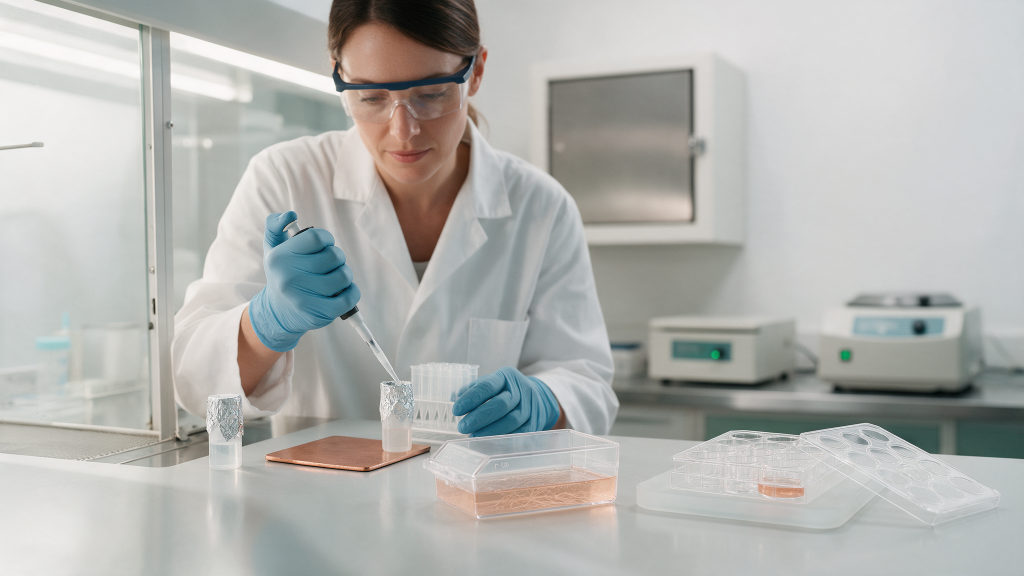
In a typical fibroblast study, researchers prepare cultures in plastic dishes or multiwell plates. They add a defined concentration of GHK-Cu to the culture medium. Control wells receive the same medium without the peptide. After an incubation period, researchers measure changes in cell number, shape, or protein output. These measurements are recorded as laboratory data. They do not describe human outcomes or therapeutic benefits.
GHK-Cu may be compared with other copper peptide blends in the same panel. This allows researchers to study structural differences between related compounds. For example, a team might include GHK-Cu, a modified copper peptide, and a non-copper control in the same experiment. Such comparisons help clarify which structural features are most relevant to the model system.
Keratinocytes form the outer layer of the skin. Keratinocyte systems are used in dermatological cell research to study skin barrier biology. These systems are often grown as monolayers or as stratified cultures that mimic the layered structure of the epidermis. GHK-Cu may be introduced into these systems to see how copper peptide structures behave in controlled cell environments.
Researchers usually record endpoints such as culture growth, morphology, and protein expression. These observations remain in-vitro only. They do not describe human outcomes. In some protocols, keratinocytes are grown on special inserts that allow the cells to form a barrier-like layer. Researchers may add GHK-Cu to the culture medium to observe whether the peptide influences measurable endpoints in this model. Again, these data are used for research comparisons only.
The combination of fibroblast and keratinocyte systems is common in skin biology studies. Researchers may run separate experiments for each cell type. Some projects use co-culture models in which fibroblasts and keratinocytes are grown together. GHK-Cu can be included in these combined systems as a reference peptide.
In-vitro skin biology research uses isolated cells or reconstructed tissue models. These models help researchers screen compounds before any later-stage study design. GHK-Cu fits into this stage because it is a small peptide with a copper ion, which makes it straightforward to prepare in standard laboratory solutions. Researchers often include GHK-Cu when building a panel of cosmetic peptides.
The goal of this type of research is to understand basic cellular responses under laboratory conditions. A typical experiment may include several concentrations of GHK-Cu. It may also include positive and negative controls. Positive controls are compounds already known to produce a measurable response in the model. Negative controls contain no active compound. This design helps researchers interpret their data accurately.
GHK-Cu research is part of a larger field of copper peptide studies. Other copper peptide blends may be tested under similar conditions. This allows research teams to compare structural features and model responses across multiple compounds. The results are reported as in-vitro observations.

GHK-Cu is sensitive to light. Researchers should store the peptide according to the product label and laboratory standard operating procedures. Avoid prolonged exposure to strong light. For specific handling details, review the GHK-Cu 50mg research peptide product page.
Proper handling is part of good laboratory practice. Peptide powders should be dissolved according to the manufacturer’s instructions. Working solutions should be prepared fresh when required. Any unused solution should be disposed of according to institutional guidelines. These practices help maintain consistency across experiments.
This information is intended for laboratory research professionals. It is not a guide for human use. No statement in this article describes a use in humans or animals. The compounds mentioned are research peptides. They are not approved by the FDA or EMA for any medical indication.
For research use only. This content is provided for in-vitro laboratory research purposes. The compounds discussed are not for human consumption and are not approved by the FDA or EMA to prevent, treat, or cure any condition. Introduction into humans or animals is prohibited by law.
