
 Best Sellers
 Metabolic
 Regenerative
 Secretagogues
 Bioregulators
 Neuropeptides









GHRP-6, GHRP-2, and Hexarelin are synthetic growth-hormone-releasing peptides studied in ghrelin receptor research. Although they belong to the same family, their structures and research histories differ. Understanding these distinctions helps researchers compare their roles in laboratory studies.

What Are GHRPs?
Growth-hormone-releasing peptides (GHRPs) are synthetic peptides investigated in research involving the ghrelin receptor and related signaling pathways. A synthetic peptide is a laboratory-produced chain of amino acids, the building blocks of proteins. GHRP-6, GHRP-2, and Hexarelin belong to this family, but their structures and research histories differ. The ghrelin receptor is also known as the growth hormone secretagogue receptor type 1a (GHS-R1a). It is a protein on the cell surface that recognizes ghrelin and certain synthetic compounds. Researchers study this receptor to understand how molecular interactions are associated with cellular signaling.
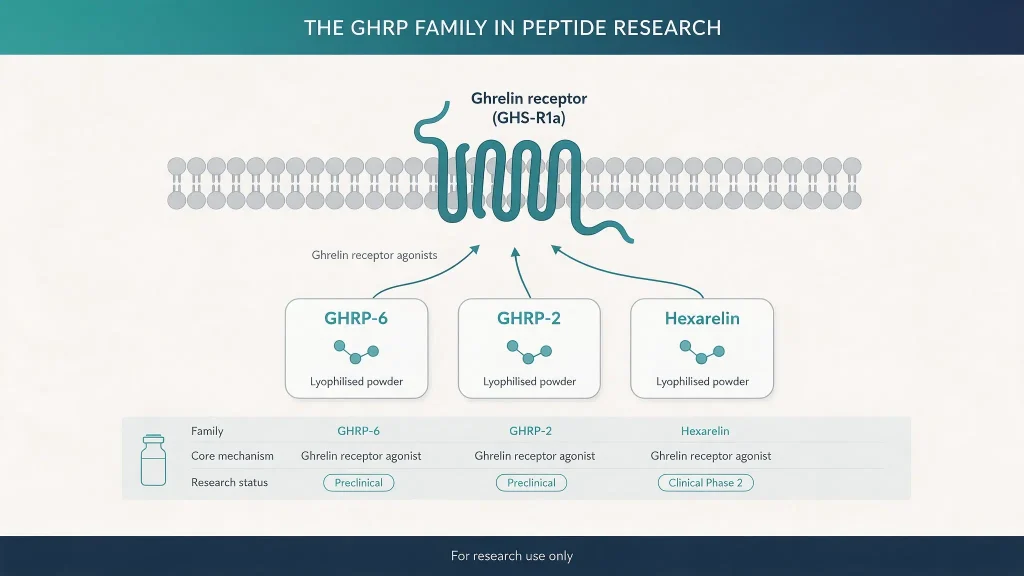
GHRPs are distinct from growth hormone-releasing hormone (GHRH) analogs. GHRH analogs are designed around the structure of GHRH and are studied in relation to the GHRH receptor. GHRPs belong to a separate structural family associated with the ghrelin receptor. Although these receptor systems are both relevant to somatotropic research, they should not be treated as interchangeable.
Somatotropic signaling refers to the biological processes associated with the growth hormone regulatory system. Research into this system can involve receptor interactions, intracellular signaling, and other molecular events. Each area represents a different level of investigation, and findings from one cannot automatically establish conclusions about another.
The three GHRPs share a broad classification, but family membership does not establish identical receptor activity or experimental behavior. Their amino acid sequences, assay-specific findings, and available evidence must be evaluated individually. For background on the receptor itself, see ghrelin receptor models in peptide research.
GHRP-6
GHRP-6 is a synthetic hexapeptide investigated in ghrelin-receptor research. A hexapeptide is a peptide made up of six amino acid residues. GHRP-6 was among the earlier synthetic growth hormone secretagogues studied in pharmacological research, before ghrelin was identified as the receptor’s natural ligand.
A ligand is a molecule that binds to a receptor. The identification of ghrelin helped establish the relationship between this naturally occurring signaling molecule and the receptor system associated with synthetic GHRPs. Earlier investigations of GHRP-6 consequently form part of the historical research context for understanding this receptor family.
Research involving GHRP-6 includes receptor-binding assays and investigations of intracellular signaling. A receptor-binding assay measures the interaction between a compound and a receptor under defined experimental conditions. Intracellular signaling refers to molecular events inside a cell that follow the reception of a signal.
These measurements answer different questions. Binding data can characterize an interaction, while a functional assay examines a defined response associated with receptor activity. A finding in one assay does not establish the same behavior across other experimental systems.
Researchers have also investigated differences in how ghrelin-receptor agonists behave across signaling assays. An agonist is a compound that activates a receptor in a particular experimental context. Assay-dependent findings matter because the measured response can vary with the method, cell model, and endpoint. Potency, for example, describes the concentration associated with a specified response in a given assay. It should not be treated as a universal ranking independent of experimental conditions.
GHRP-6 is therefore relevant to comparative studies of receptor recognition, signaling behavior, and relationships between peptide structure and measured activity. Research reports should identify the model, controls, analytical methods, and endpoint used. These details help distinguish directly measured findings from broader interpretations.
For compound-specific reference, see the GHRP-6 research peptide. The linked page identifies the 5 mg presentation. This reference is separate from the scientific evidence and does not establish a particular level of experimental performance.
GHRP-2
GHRP-2 is another synthetic hexapeptide examined in research involving growth hormone secretagogue receptors. It belongs to the same broad family as GHRP-6, but the two compounds have different amino acid sequences. Sequence differences can influence molecular interactions, although the nature and extent of those differences must be established through appropriate experiments.
GHRP-2 appears in the historical literature on synthetic growth hormone-releasing peptides and their analogs. This literature contributes to the development of the broader GHRP research field. However, historical classification does not mean that every peptide has been investigated using the same experimental models or analytical methods.
In comparative peptide research, GHRP-2 can be examined alongside GHRP-6 to investigate how related structures behave in a shared receptor system. Researchers may compare receptor-binding measurements or functional assay data, provided the studies use sufficiently comparable conditions.
Receptor expression is one factor that can affect interpretation. It refers to the amount of a particular receptor produced by the cells in an experimental model. Differences in receptor expression can influence measurements, making it important to document the model and its relevant characteristics.
The assay endpoint also matters. An endpoint is the specific measurement used to evaluate an experiment. A binding endpoint describes receptor interaction, while a functional endpoint measures a defined response in the experimental system. These measurements should be reported separately rather than combined into a single conclusion about a compound’s overall activity.
Published findings should also be attributed to the correct peptide. Evidence involving GHRP-6 or Hexarelin cannot automatically be used to establish an equivalent property for GHRP-2. Shared classification is a starting point for comparison, not proof of identical behavior.
For compound-specific reference, see the GHRP-2 research peptide. The linked page identifies the 5 mg presentation. The page reference does not establish the compound’s behavior in a particular laboratory assay.
Hexarelin
Hexarelin is a synthetic hexapeptide investigated in research involving growth hormone secretagogue receptors and related signaling systems. Like GHRP-6 and GHRP-2, it belongs to the broader GHRP family. Its distinct structure and research history mean that evidence from the other compounds should not automatically be applied to Hexarelin.
Early pharmacological investigations examined Hexarelin alongside other synthetic secretagogues. Pharmacology is the study of how compounds interact with biological systems. This research contributed to the characterization of the receptor system associated with the GHRP family and helped distinguish it from GHRH-related signaling.
Hexarelin has also been discussed in studies of cellular signaling and other proposed biological mechanisms. A proposed mechanism is an explanation of how a compound might be associated with an observed effect. Such an explanation requires evidence appropriate to the model, and a hypothesis should not be presented as an established mechanism without sufficient supporting data.
For example, a cellular assay may measure a specific molecular response under controlled conditions. That observation does not, by itself, establish the same response in a more complex biological system. Similarly, evidence involving a related receptor or pathway does not demonstrate identical activity across all experimental models.
When comparing Hexarelin with GHRP-6 and GHRP-2, researchers should identify the compound, receptor system, assay endpoint, and evidence type. They should also consider whether the cited study directly examined Hexarelin or discussed the GHRP family more broadly.
Differences in publication history or the number of available studies should not be interpreted as proof that one compound is universally more suitable for a research question. The relevance of each peptide depends on the specific experimental objective and the evidence available for the property being investigated.
For compound-specific reference, see the Hexarelin research peptide. The linked page identifies the 5 mg presentation. This reference does not establish a particular level of purity, stability, receptor activity, or experimental performance beyond what is documented in the relevant specifications.
Comparison Table
The three compounds share a broad research classification, but their evidence bases should be assessed individually. The table summarizes their general research context without assigning unsupported rankings or predicting experimental outcomes.
| Research feature | GHRP-6 | GHRP-2 | Hexarelin |
| Compound class | Growth-hormone-releasing peptide | Growth-hormone-releasing peptide | Growth-hormone-releasing peptide |
| Peptide length | Hexapeptide | Hexapeptide | Hexapeptide |
| Receptor context | Ghrelin receptor, GHS-R1a | Ghrelin-receptor system | Ghrelin-receptor system |
| Research context | Receptor binding and intracellular signaling | Comparative receptor and functional research | Receptor pharmacology and investigated signaling mechanisms |
| Evidence consideration | Interpret measurements within the assay used | Assess findings against the specific model and endpoint | Separate measured findings from proposed mechanisms |
| Listed presentation | 5 mg reference | 5 mg reference | 5 mg reference |
A research model is the experimental system used to investigate a scientific question. Examples include receptor-based assays and cultured cells. The receptor context in the table identifies the system associated with the family’s classification; it does not mean that every possible interaction has been established for every compound.
The listed presentations are page references, not evidence of equivalent analytical quality or biological activity. Identity, purity, stability, and assay performance are separate properties that require appropriate documentation and testing.
Choosing a Compound for Research
Comparative peptide research begins with a clearly defined scientific question. Researchers should identify the receptor, pathway, or molecular interaction under investigation before assessing which published findings are relevant. This approach keeps comparisons focused on evidence rather than assumptions based on a compound’s name or family classification.
First, identify the target receptor system. The ghrelin receptor is distinct from the GHRH receptor. Evidence involving one receptor should not be assumed to answer a question about the other. Researchers examining broader pathway relationships can also consult GHRH-related signaling research and somatotropic pathway research.
Second, define the endpoint. Binding assays, functional assays, and stability analyses measure different properties. Selecting the endpoint in advance helps ensure that conclusions remain aligned with the data collected.
Third, evaluate the evidence for each individual compound. Review the experimental model, controls, analytical methods, limitations, and source of each finding. Preclinical evidence should remain identified as preclinical, and proposed mechanisms should not be presented as established facts unless directly supported by suitable evidence.
Finally, consider analytical characterization. Compound identity confirms what is being examined, purity analysis evaluates detectable components, and stability studies investigate changes under specified conditions. No single measurement automatically establishes all these properties.
Researchers exploring the broader compound family can review the secretagogue peptides category. This provides additional context for related research topics. Ultimately, GHRP-6, GHRP-2, and Hexarelin are best compared through compound-specific evidence, clearly defined endpoints, and consistent experimental criteria.
For Research Use Only
GHRP-6, GHRP-2, and Hexarelin are discussed here solely in the context of in-vitro and laboratory research. Scientific statements should be interpreted according to the compound, experimental model, endpoint, and evidence supporting each claim.
Receptor studies and other laboratory observations do not independently establish clinical outcomes or comprehensive safety. The absence of a reported effect in a particular experiment does not prove safety. Likewise, proposed mechanisms should remain identified as hypotheses until supported by appropriate evidence.
For research use only. This content is provided for in-vitro laboratory research purposes. The compounds discussed are not for human consumption and are not approved by the FDA or EMA to prevent, treat, or cure any condition. Introduction into humans or animals is prohibited by law.
References
- Bowers CY, Momany FA, Reynolds GA, Hong A. On the in vitro and in vivo activity of a new synthetic hexapeptide that acts on the pituitary to specifically release growth hormone. Endocrinology. 1984;114(5):1537–1545.
- Momany FA, Bowers CY, Reynolds GA, Hong A, Newlander K. Conformational energy studies and in vitro and in vivo activity data on growth hormone-releasing peptides. Endocrinology. 1984;114(5):1531–1536.
- Howard AD, Feighner SD, Cully DF, et al. A receptor in pituitary and hypothalamus that functions in growth hormone release. Science. 1996;273(5277):974–977.
- Kojima M, Hosoda H, Date Y, Nakazato M, Matsuo H, Kangawa K. Ghrelin is a growth-hormone-releasing acylated peptide from stomach. Nature. 1999;402(6762):656–660.
- Smith RG, Van der Ploeg LH, Howard AD, et al. Peptidomimetic regulation of growth hormone secretion. Endocrine Reviews. 1997;18(5):621–645.
- Bowers CY. Unnatural growth hormone-releasing peptide begets natural ghrelin. Journal of Clinical Endocrinology & Metabolism. 2001;86(4):1464–1469.
- Camanni F, Ghigo E, Arvat E. Growth hormone-releasing peptides and their analogs. Frontiers in Neuroendocrinology. 1998;19(1):47–72.
- Bowers CY. Growth hormone-releasing peptide (GHRP). Cellular and Molecular Life Sciences. 1998;54(12):1316–1329.
- Bodart V, Bouchard JF, McNicoll N, et al. Identification and characterization of a new growth hormone-releasing peptide receptor in the heart. Circulation Research. 1999;85(9):796–802.
- Ong H, McNicoll N, Escher E, et al. Identification of a pituitary growth hormone-releasing peptide (GHRP) receptor subtype by photoaffinity labelling. Endocrinology. 1998;139(1):432–435.
- Davenport AP, Bonner TI, Foord SM, et al. International Union of Basic and Clinical Pharmacology. LVI. Ghrelin receptor nomenclature, distribution, and function. Pharmacological Reviews. 2005;57(4):541–546.
- Müller EE, Locatelli V, Cocchi D. Neuroendocrine control of growth hormone secretion. Physiological Reviews. 1999;79(2):511–607.
- Korbonits M, Goldstone AP, Gueorguiev M, Grossman AB. Ghrelin—a hormone with multiple functions. Frontiers in Neuroendocrinology. 2004;25(1):27–68.
- Cheng K, Chan WW, Barreto A Jr, Convey EM, Smith RG. The synergistic effects of His-D-Trp-Ala-Trp-D-Phe-Lys-NH2 on growth hormone (GH)-releasing factor-stimulated GH release and intracellular cAMP accumulation in rat primary pituitary cell culture. Endocrinology. 1989;124(6):2791–2798.