Your cart is empty.
- Categories

LL-37 is a frequently studied antimicrobial peptide in laboratory research. The compound is a 37-amino-acid peptide derived from the human cathelicidin precursor protein. Researchers examine it in controlled in-vitro models to investigate how peptides interact with lipid membranes. This article provides a research-use-only overview of LL-37, its molecular characteristics, and the experimental systems used to study it.
LL-37 is a short peptide chain made of 37 amino acids. An amino acid is a small molecular building block that joins with other amino acids to form a peptide or protein. The compound belongs to the cathelicidin family. Cathelicidins are a group of antimicrobial peptides produced as precursor proteins and processed to release smaller peptide fragments.
Two molecular features are central to LL-37 research. The first is its net positive charge under commonly studied conditions. This charge comes partly from amino acids such as arginine and lysine. The second is its amphipathic structure. Amphipathic means that different regions of a molecule interact differently with water and fat-like environments. These properties make LL-37 relevant to membrane-interaction research.
The human CAMP gene encodes the cathelicidin precursor protein known as hCAP18. Enzymes process this precursor to release LL-37. The peptide’s name refers to its two initial leucine residues and its total length of 37 amino acids. Leucine is one of the amino acids that make up the peptide sequence.
Researchers examining this compound can consult the LL-37 research peptide page for its product-specific information. The scientific literature also provides background on its molecular structure and classification. A review published in Biochimica et Biophysica Acta discusses LL-37’s structural properties and membrane interactions.
An antimicrobial peptide is a short chain of amino acids investigated for its interactions with microorganisms and their membranes. A host-defence peptide is a related term for a peptide examined in the context of an organism’s innate defence systems. LL-37 is described using both terms in scientific literature.
Antimicrobial peptide research often examines how these molecules interact with lipid membranes rather than focusing on a single enzymatic target. A lipid membrane is a thin barrier formed mainly from fat-like molecules that separates a cell’s interior from its surroundings. Researchers use simplified membrane systems to investigate peptide structure, membrane binding, and changes in membrane organisation.
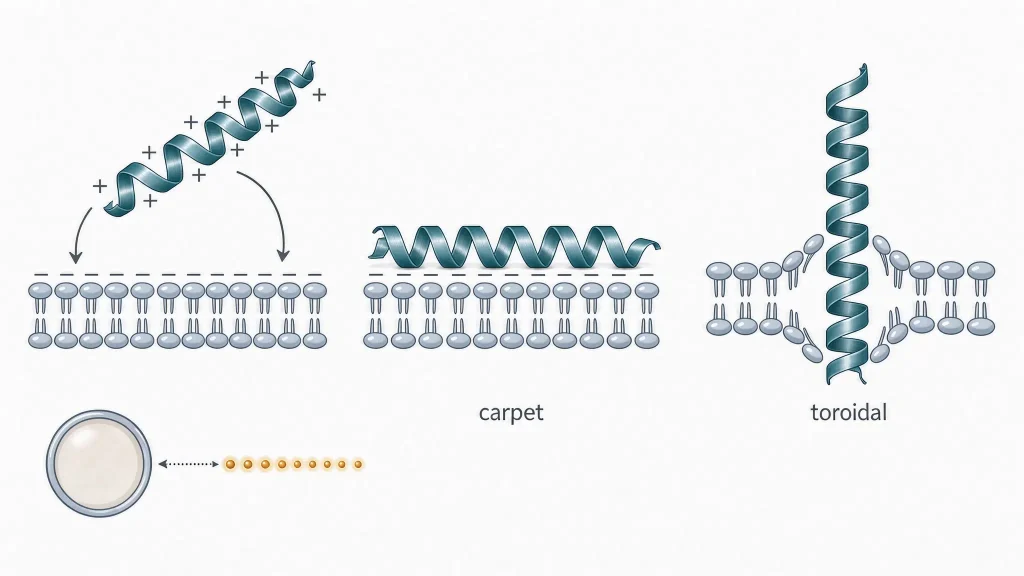
Membrane contact is influenced by electrical charge. Positively charged regions of a peptide can interact with negatively charged phospholipid head groups. Phospholipids are fat-like molecules that form the main structure of many biological membranes. Differences in membrane composition are important experimental variables. Bacterial membranes and mammalian cell membranes differ in their lipid composition and surface properties. Researchers use these differences to compare peptide interactions under defined laboratory conditions.
Several experimental systems support this work:
Researchers also compare different structural models. The pore model proposes that peptides form channel-like structures in a membrane. The carpet model proposes that peptides accumulate on a membrane surface and may disrupt its organisation. The toroidal model describes a proposed channel structure in which the membrane bends around the opening. These models are interpretations of experimental observations, and their relevance can vary with the peptide and conditions studied.
An in-vitro model is an experiment performed outside a living organism, usually in a laboratory vessel or instrument. These models allow researchers to control variables such as concentration, salt level, pH, and temperature.

Common experimental approaches include:
Each method has limitations. Salt concentration, the composition of the culture medium, and other experimental variables can affect measurements. Reporting these conditions is essential when comparing findings across studies.
LL-37 is also examined in cell culture models involving molecular signalling. Cell culture is the growth of cells under controlled laboratory conditions. Researchers may investigate gene transcription, receptor interactions, and changes in signalling markers within these systems.
Cytokine expression assays in thymic peptide research use related analytical approaches. A cytokine is a small signalling protein involved in communication between cells. An assay is a laboratory test designed to measure a specific variable.
Common readouts include messenger RNA levels measured by quantitative polymerase chain reaction (qPCR), protein levels measured by enzyme-linked immunosorbent assay (ELISA), and reporter gene activity. Messenger RNA carries genetic instructions used in protein production. These measurements describe observations in defined experimental systems and should not be interpreted as evidence of clinical outcomes.
LL-37 is of interest in antimicrobial peptide research because its molecular structure provides a framework for examining interactions between peptides and membranes. Researchers can compare structural models, membrane composition, and experimental conditions to investigate how these variables relate to observed molecular behaviour.
Research also examines LL-37 in cell-based systems to characterise its interactions with cellular signalling pathways. These studies involve distinct experimental questions and should be evaluated according to their methods and evidence.
Analytical quality is another important consideration. Mass spectrometry is a technique used to assess molecular mass and support peptide identity verification. High-performance liquid chromatography (HPLC) is a separation method used to assess sample composition and purity. Appropriate analytical documentation helps researchers evaluate the identity and quality of the material used in an experiment.
LL-37 belongs to a wider research area involving thymic peptides. Related topics include [thymic peptides and T-cell differentiation models] and [cytokine expression assays in thymic peptide research]. These areas provide additional context for understanding how researchers investigate peptide-related molecular pathways in controlled laboratory systems.
LL-37 research focuses on molecular structure, membrane interactions, and observations from defined in-vitro models. Findings should be interpreted in the context of each study’s methods, limitations, and evidence level. Laboratory observations alone do not establish broader biological effects or demonstrate safety.
For research use only. This content is provided for in-vitro laboratory research purposes. The compounds discussed are not for human consumption and are not approved by the FDA or EMA to prevent, treat, or cure any condition. Introduction into humans or animals is prohibited by law.