
 Best Sellers
 Metabolic
 Regenerative
 Secretagogues
 Bioregulators
 Neuropeptides







This article is written for academic researchers and professionals qualified to handle research-grade compounds. It is a laboratory reference and is not intended for clinical use.
The somatotropic pathway is the signaling circuit involved in growth hormone (GH) release. Growth hormone is a protein produced by the pituitary gland that acts on tissues throughout the body. Peptides are common tools in in-vitro signaling research. In-vitro means conducted outside a living organism, such as in a laboratory dish. A peptide is a short chain of amino acids, the building blocks of proteins. This overview covers the pathway, its receptors, and laboratory methods used to measure signaling.

What Is the Somatotropic Pathway?
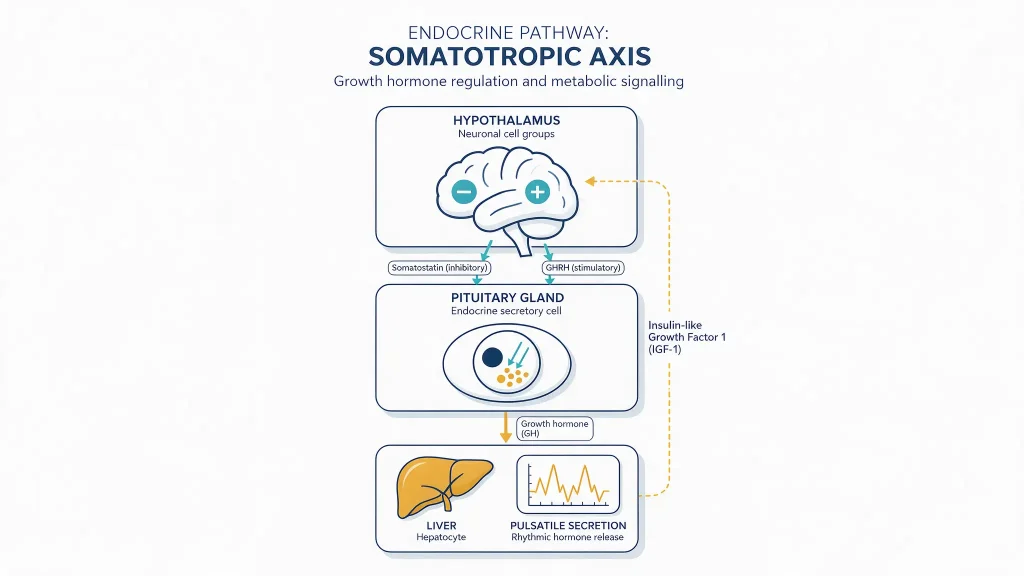
The somatotropic axis is the chain of tissues involved in growth-related signaling. It runs from the hypothalamus to the pituitary gland, with downstream signaling involving the liver and other tissues. The hypothalamus is a brain region that helps regulate the system. The pituitary is a small gland beneath the brain.
GH is produced by somatotroph cells. A somatotroph is a pituitary cell that produces and stores growth hormone. These cells receive three main regulatory inputs. GHRH, or growth hormone-releasing hormone, stimulates GH secretion. Ghrelin is another signal that acts through a different receptor. Somatostatin is an inhibitory signal. These inputs influence the pattern of GH secretion.
GH also acts on the liver, which produces IGF-1. IGF-1 is a hormone involved in growth-related signaling that also participates in feedback regulation of the brain and pituitary. This feedback loop allows researchers to measure inputs and downstream signals.
Receptors Studied in This Pathway
A receptor is a protein that detects a signal by binding to a specific molecule. Three receptor systems are relevant to somatotropic pathway research.
The GHRH receptor
The GHRH receptor is the binding site for GHRH on somatotroph cells. It is a GPCR. A G protein-coupled receptor (GPCR) transmits signals across the cell membrane through G proteins. The GHRH receptor couples to Gs, a G protein that activates adenylate cyclase. Adenylate cyclase is an enzyme that produces cAMP, a small messenger molecule that relays signals inside the cell. In laboratory models, cAMP signaling and GH secretion can be measured as separate readouts.
For study design, cAMP assays provide a functional readout, while the receptor can undergo desensitization. Desensitization means that a cell responds less strongly to a signal after continued or repeated exposure. Continuous and pulsed exposure can therefore produce different measured responses. More background is covered in [GHRH-related signalling research].
The ghrelin receptor
The ghrelin receptor, also called GHSR-1a, is the receptor for ghrelin. It can couple to Gq, a G protein that activates phospholipase C. This enzyme can trigger calcium release from stores inside a cell. Calcium signaling provides a readout distinct from the cAMP pathway associated with GHRH receptor activity.
Appropriate readouts and antagonist controls can help researchers distinguish the two pathways. An antagonist is a compound that binds to a receptor and blocks or reduces its activation. The ghrelin receptor also shows constitutive activity, meaning it can signal at a baseline level without an external ligand. A ligand is a molecule that binds to a receptor. Studies should account for this baseline when interpreting measurements.
Somatostatin receptors
Somatostatin acts through receptors that include SSTR2 and SSTR5 on somatotroph cells. These receptors can couple to Gi, a G protein that inhibits adenylate cyclase and reduces cAMP production. Somatostatin can serve as an inhibitory control in suitable models. An inhibitory control is a condition expected to reduce a measured signal. Researchers can compare responses against this control when assessing whether a change is consistent with the pathway under investigation.
Peptides Used in Somatotropic Research
A secretagogue is a substance studied for its role in stimulating secretion. Secretagogue peptides are short amino acid chains investigated for interactions with receptors involved in GH secretion. Related compounds are discussed in the secretagogue peptides research category.
GHRH receptor agonists
An agonist is a compound that binds to and activates a receptor. GHRH analogs are modified versions of the natural hormone. Their modifications can influence stability and receptor activity under experimental conditions.
Tesamorelin is a synthetic GHRH analog with a modification at its N-terminus. The N-terminus is the starting end of a peptide chain. Its structure has been investigated in relation to peptide stability and pharmacokinetic properties. Pharmacokinetics, or PK, describes how a compound moves through and is processed by a biological system. Claims about enzyme resistance and stability require primary sources and should not be generalized beyond the conditions studied.
Sermorelin corresponds to the first 29 amino acids of GHRH. The 1-29 label identifies this segment of the full hormone. In in-vitro receptor studies, Sermorelin is examined for activity at the GHRH receptor and can serve as a reference compound in comparative signaling experiments.
CJC-1295 is another modified GHRH analog. Its design has been investigated in relation to peptide persistence and pharmacokinetic properties. Findings should be distinguished by evidence type, including preclinical research and early-phase PK studies where applicable. Broader mechanistic interpretations remain hypotheses unless supported by direct experimental evidence.
Ghrelin receptor agonists
Ghrelin mimetics are compounds studied for their ability to interact with the GHSR-1a receptor in ways similar to ghrelin. They are used in research examining calcium-related signaling. The GHRP family is one example, discussed in [the GHRP family in peptide research]. GHRP stands for growth hormone-releasing peptide.
Because the ghrelin receptor can show constitutive activity, each experimental plate should include an appropriate vehicle control. A vehicle control contains the carrier solution without the test compound. Results can be reported as changes relative to the basal signal, which is the measured activity without the added test compound.
Common Research Methods
GH secretion models
GH secretion models measure GH release under defined laboratory conditions. The following approaches represent different in-vitro model types.
Cell lines. GH3 and GH4C1 are rat pituitary-derived cell lines used in endocrine research. Their hormone production and receptor expression can differ from native pituitary cells. Findings may need confirmation in a primary system. A primary system uses cells obtained directly from tissue.
Primary cells and explants. Cells isolated from pituitary tissue can retain aspects of native receptor expression. An explant is a small piece of tissue maintained in a laboratory setting, allowing some cell-to-cell interactions to remain intact.
Perifusion systems. These systems flow culture medium across cells or tissue and collect samples over time. They allow researchers to measure changes in GH secretion patterns that may not be captured by a single measurement in static culture.
Binding assays and functional readouts
A binding assay measures how a peptide interacts with its receptor. Functional assays measure signaling responses associated with that interaction. Common readouts include:
- cAMP accumulation, measured using immunoassays or luminescent sensors. An immunoassay uses antibodies to detect a target molecule.
- Calcium flux, measured using fluorescent dyes and a plate reader. Calcium flux refers to changes in calcium concentration within a cell.
- GH protein in culture medium, measured by ELISA. ELISA is an antibody-based method used to quantify a target molecule.
- Reporter activity. A reporter assay links a signaling process to a measurable output, such as light.
These readouts are discussed in [second-messenger cascade analysis in secretagogue research]. A second messenger is a molecule, such as cAMP or calcium, that relays a signal inside a cell.
Design Considerations
Each experiment should include an appropriate vehicle control, a positive control, and a receptor antagonist where suitable. A positive control is a condition expected to produce a known response. Antagonist controls can help assess whether an observed effect involves the receptor under study. Without appropriate controls, a response cannot be confidently attributed to a specific receptor.
Passage number, serum batch, temperature, and incubation time can affect measured GH output and should be reported. Passage number indicates how many times a cell line has been subcultured. Concentration ranges should be justified within the research protocol. In-vitro findings describe a specific experimental model and should not be assumed to represent the entire somatotropic pathway.
For Research Use Only
This article describes laboratory research on compounds studied in vitro. It is not a clinical or prescribing reference. Evidence in this field includes in-vitro studies, preclinical research, and early-phase pharmacokinetic studies. Hypothesized mechanisms should be distinguished from directly measured findings. Limited evidence or an absence of reported adverse effects should not be interpreted as proof of safety. For research use only. This content is provided for in-vitro laboratory research purposes. The compounds discussed are not for human consumption and are not approved by the FDA or EMA to prevent, treat, or cure any condition. Introduction into humans or animals is prohibited by law.